
At the UN Centre in Vienna, attention is first drawn to everything external: security checks, name tags, headphones, and a meeting hall where countries take turns speaking in carefully considered sentences. Only after a while do you realise that the real tension lies in what ultimately remains in the documents—and what is removed from them.
I have been following the meetings of the UN Commission on Narcotic Drugs (CND) since 2017. This spring, I was involved for the first time in ways beyond simply observing. That also changed my own relationship to the event. When you are speaking at a side event, meeting people, and following negotiations closely, the whole meeting opens up as a place where it is decided in what language people who use drugs can be discussed.
Words matter
In drug policy, words are instruments of power.
When Member States argue about whether a resolution can refer to harm reduction, they are debating more than just terminology. It is about what kinds of measures are considered politically acceptable. Can drug-related harm be reduced in practical ways that protect people, or should politics remain so cautious at the level of language that reality is excluded?
In Finland, harm reduction is already an established part of the discussion. At the international level, however, the term still creates tension. This quickly becomes apparent when following both official sessions and informal negotiations. One country wants to delete the term, another softens it, and a third accepts it only with a footnote. From the outside, it may look like a minor textual issue.
In practice, it reveals how much resistance there still is to evaluating drug policy from the perspectives of health, human rights and basic survival.
This year, Finland and Norway introduced a joint resolution seeking to promote integrated, coherent, and evidence-based systems for drug-related public health interventions. At the UN level, this is significant, as each such reference opens a little more space for realism.
The weight of the resolution is primarily symbolic—but international drug policy often changes first at the symbolic level. Only in recent years has harm reduction gained a more visible foothold in the Commission’s language, and even now, footnotes still note that not all Member States agree with the concept.
The Nordic countries sought a common voice
This year’s meeting was also noteworthy for the Nordic countries. A side event organised by the Norwegian organisation Foreningen for Human Ruspolitikk focused on human rights and the emerging Nordic network of user organisations and their allies.
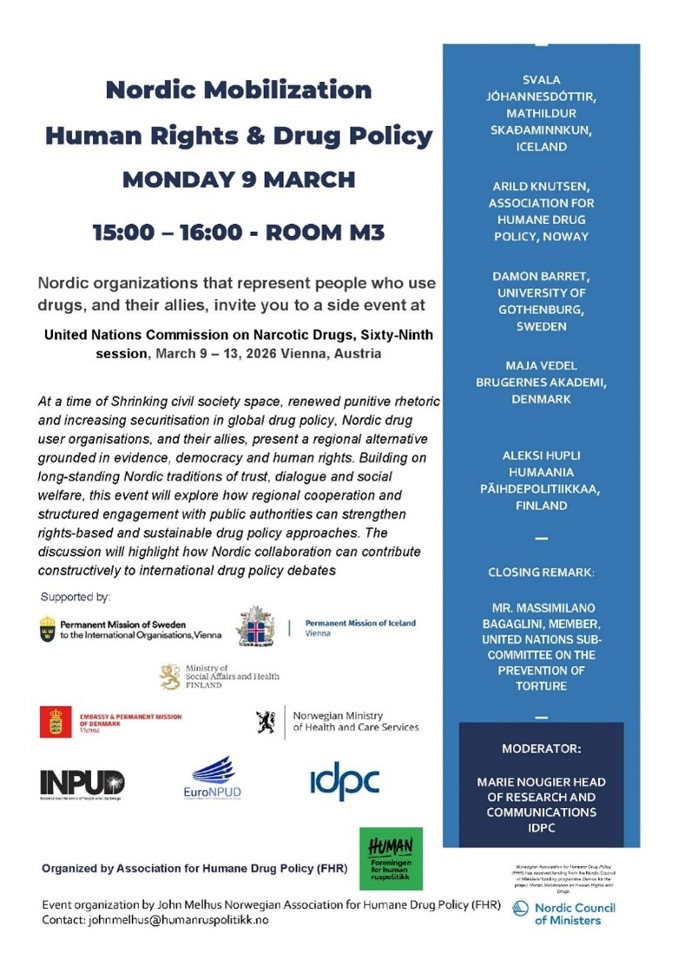
I participated by giving a short intervention as a representative of the Finnish Association for Humane Drug Policy. The event was supported by NGOs and official institutions from across the Nordic countries, including the Finnish Ministry of Social Affairs and Health.
There was something in the room that cannot be taken for granted in the UN drug policy ecosystem:
Lived experience, research, the practical knowledge of organisations, and institutional perspectives came together—if only for a moment.
This felt significant, because the Nordic countries are still viewed in two ways at once. We are seen as welfare states, yet many of our drug policy practices and laws have long been harsh, moralising and slow to change.
That is why the Nordic voice can be credible when it dares to speak openly about preventing drug-related deaths, improving access to services, and upholding human dignity. Internationally, such positions are noticed.
Corridors speak about consequences
The official programme focuses on resolutions, classifications and procedures. In the corridors, people talk about why individuals lack access to treatment, why people die from overdoses, why stigma keeps people away from services, and why the system resists change even when its harms are well known.
This year, more than 2,000 people from 134 countries participated in the Commission. There were over 900 representatives from civil society, representing nearly 200 organisations. Around 170 side events were held during the week.
These numbers alone show that drug policy is no longer shaped solely by nation states behind closed doors. This is an important shift—even if power remains unevenly distributed.
That contradiction stood out most clearly to me. The system listens more than before, but still shares little of its power. Experts with lived and living experience, user organisations and researchers are increasingly given a voice, but many crucial decisions are still made in rooms to which they have no access.
The coca leaf shows whose knowledge counts
One of the most controversial issues this year concerned the coca leaf. A critical review completed by the World Health Organization at the end of 2025 recommended that coca remain in the same international classification category as cocaine, even though the use of the coca leaf itself was not found to pose significant public health risks. The justification was its role in cocaine production.
From a Western perspective, this decision may appear technical. In Vienna, it did not feel that way. In the Andean and Amazonian regions, coca is part of culture, history, labour, medicine and community life. Although the international system partially recognises its cultural significance, it still keeps it under strict control.
This illustrates how, within the UN drug control system, the perspective of prohibition often outweighs local and cultural knowledge.
This also resonates in Finland. Cocaine use is often framed as a moral issue, with users blamed for funding organised crime. This perspective is understandable—but overly simplistic. It obscures the fact that the current international control system is a political construct shaped by policymakers, not by users. When production and trade are illegal, they are inevitably managed by criminal markets, bringing violence, environmental harm and exploitation.
Change is slow—but real
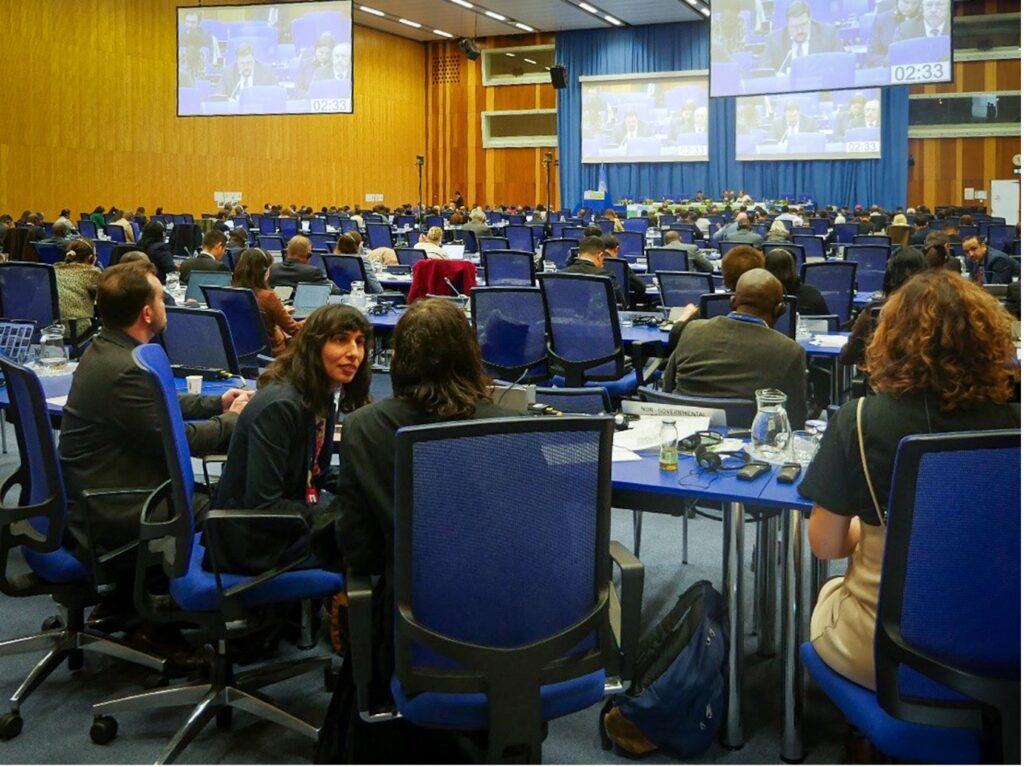
It would be easy to become frustrated with the UN Commission on Narcotic Drugs. Meetings are long, compromises diluted, and many issues are buried in language far removed from everyday reality. Yet it is precisely there that one can observe how change is actually happening.
Change happens when harm reduction becomes a term that can no longer be removed without resistance. It happens as the presence of NGOs continues to grow. It happens as more countries are forced to justify adherence to policies with well-documented human costs.
What stayed with me most this time in Vienna is that the system is no longer completely stagnant. That is why it is important to be present. That is why it is important to speak.
And that is why Finland, too, must decide what kind of voice it wants to bring to these tables.
If policymakers genuinely want to reduce drug-related deaths, infections, violence and social exclusion, they should pay close attention to moments when a single word is contested—or accepted—in Vienna’s negotiation rooms. Often, the direction of global drug policy is reflected in those words.


