
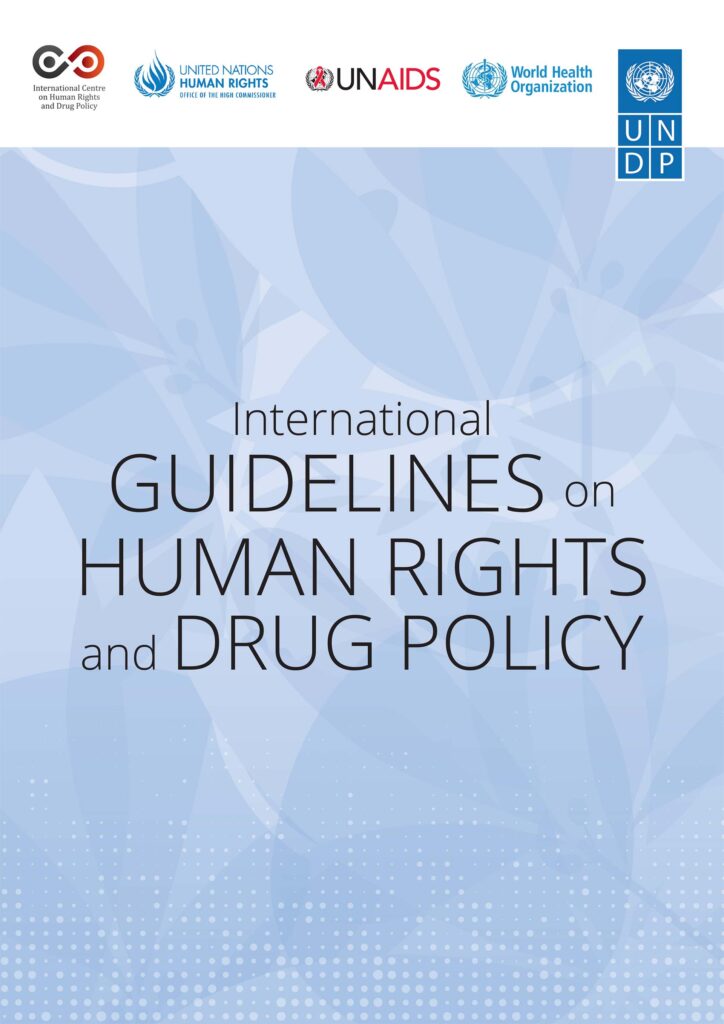
The International Guidelines on Human Rights and Drug Policy were launched in 2019 after a three-year global consultation process involving academics, UN agencies, civil society organisations, and affected communities. The document was developed to clarify how international human rights law should be applied in the context of drug control policies and practices.
Rather than proposing a single “model drug policy,” the Guidelines serve as a practical reference tool for governments, judges, policymakers, lawyers, activists, health professionals, and communities seeking to ensure that drug policies comply with human rights standards. The Guidelines address issues such as the right to health, harm reduction, access to essential medicines, freedom from torture, alternatives to incarceration, the abolition of the death penalty for drug offences, indigenous rights, and the meaningful participation of affected communities.
Importantly, the document emphasises that drug offences do not meet the threshold of “most serious crimes” under international law and therefore should not be punishable by death. It also encourages evidence-based harm reduction services, voluntary treatment, and the decriminalisation of drug possession for personal use as possible pathways toward protecting health and human dignity.
In this new Drugreporter short film, experts from different countries reflect on how the Guidelines have been used in practice — from legal advocacy and policy reform efforts to court cases, public health initiatives, and campaigns against punitive drug laws. Their experiences show how international human rights standards can become concrete tools for change in very different political and cultural contexts.
The film highlights a growing global movement that seeks to move drug policy away from punishment and toward health, dignity, evidence, and human rights.
Featured experts in the film
- Alan Miller — Independent Chair, National Collaborative of Drug Mission, Scotland
- Ann Fordham — Executive Director, International Drug Policy Consortium
- Anton Basenko — Executive Director, International Network of People who Use Drugs
- Boyan Konstantinov — Policy Specialist, HIV, Health and Development, UNDP
- Claudia Braga — Professor, University of Sao Paolo
- Ganna Dovbakh — Executive Director, Eurasian Harm Reduction Association
- Isabel Pereira — Programme Director, Drug Policy, Dejusticia (Colombia)
- John Walsh — Director for Drug Policy and the Andes, Washington Office on Latin America (USA)
- Julie Hannah, Director, International Center on Human Rights and Drug Policy, University of Essex
- Laura Gil Savastano — Former Ambassador, Embassy and Permanent Mission of Colombia
- Lisa Sanchez — Former Executive Director, MUCD (Mexico)
- Maria-Goretti Loglo — Africa Consultant, International Drug Policy Consortium
- Nara de Araújo — Director of Prevention and Social Reintegration, SENAD (Brazil)
- Aqeel Malik — Minister of State and Law, Pakistan
- Zaved Mahmood — Senior Advisor, Human Rights and Drug Policy, Office of the United Nations High Commissioner for Human Rights (OHCHR)
Video by István Gábor Takács
Expert consultation: Julie Hannah


