


With the participation of numerous government organisations, the National AIDS Strategy was implemented via a project called "Support for NAS Implementation", supported by the Global Fund to Defeat Malaria, Aids and Tubercolosis and the United Nations Development Program, in Podgorica. Within this project, preventive services for the most vulnerable groups were provided in community-based NGOs.
Although one of the goals of the nine-year program was to secure the sustainability of service provision, our government has failed to achieve this, despite the supporting opinion of the Ministry of Health and Institute for Public Health, who emphasised the importance of this type of service to the community.
Today, Harm Reduction program is limited to just one drop-in centre for people who inject drugs (PWID), while all other centres have been closed, as well as the mobile outreach program.
In cooperation with the Andrija Stampar School for Public Health, in Croatia, the Montenegro Institute for Public Health produced an estimate of the number of people who were injecting drugs in August 2012. Data received show that 1282 (0.7% of total population) PWID live in Podgorica. At the same time, Juventas provided services for 596 PWID in Podgorica – 46% of the estimated number. The increase in the number of people using Juventas' services can be correlated to an increase in the number of people who inject drugs in Montenegro.
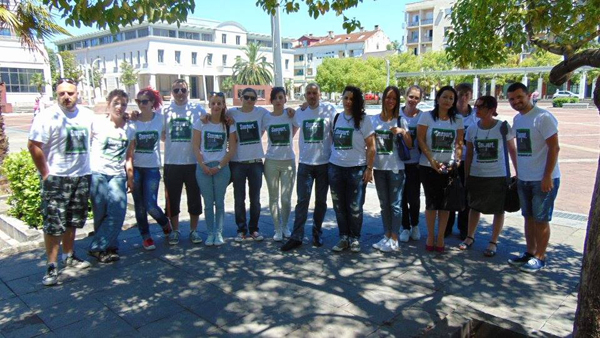
Support. Don't Punish campaign event in Montenegro
Support. Don't Punish campaign event in Montenegro
On the other hand, in 2014, Juventas provided services for around 627 PWIDs (15% female) and 157 female sex workers in this city (population 187,805), home to one-third of the total Montenegrin population. Through 5,191 contacts with PWID and 1,686 with sex workers, we provided them with 22,355 needles, 15,663 syringes and 16,330 condoms. We provided 1123 counselling sessions for 293 prisoners during the same period.
Although the HIV prevalence among PWID is still low (1% of the total number of registered cases), the prevalence of viral hepatitis C is 55%, and figures from harm reduction service providers show that there has been a steady increase in the number of PWID, over the last few years.
Cost/benefit analysis shows that in Montenegro, preventive services for one client cost from 6 to 10 Euros per month, while HIV infection treatment costs from 1200 to 1500 Euros, and hepatitis C infection from 1500 to 2000 Euros per month.
Due to the fact that the Government of Montenegro, despite the supporting expert opinions of the Ministry of Health and Institute for Public Health, as well as strong recommendations from international donors, has not demonstrated the political will to secure the sustainability of prevention services in our community, we have to inform you that most services closed on June 30th, while we have managed to secure funds to provide a skeleton service for the next three months (a needle and syringe program staffed by two people). This means that on October 1st at the latest, we are going to be forced to close the only centre for harm reduction service provision, and leave people in the most vulnerable populations on their own, exposed to a much higher risk of contracting HIV and viral hepatitis C.
An additional obstacle that we have encountered in our efforts to save services from closure, has been the silent campaign against harm reduction programs among key decision-makers, carried out by NGO colleagues working in the field of drug prevention, following UN Office on Drugs and Crime guidelines on the issue.
In view of all of the above, we would very much appreciate any support you can offer in the months to come.
Tijana Žegura – Director of Harm Reduction Program Juventas
Photos: Drazen Zegura, Balesti zavisnosti
Photos: Drazen Zegura, Balesti zavisnosti


